

Why The Body Keeps the Score Became More Powerful Than the Science Behind It
Updated: Aug 5
About This Review
At Escape the System, our book reviews ask a simple question:
Are a book's scientific claims supported by credible evidence?
This is not a review of whether a book is inspiring, enjoyable, or personally meaningful. Many books contain valuable ideas without being based on scientific research.
Our goal is simply to help readers distinguish between scientific evidence, personal opinion, and speculation.
Some books become popular because they tell people what they desperately want to believe.
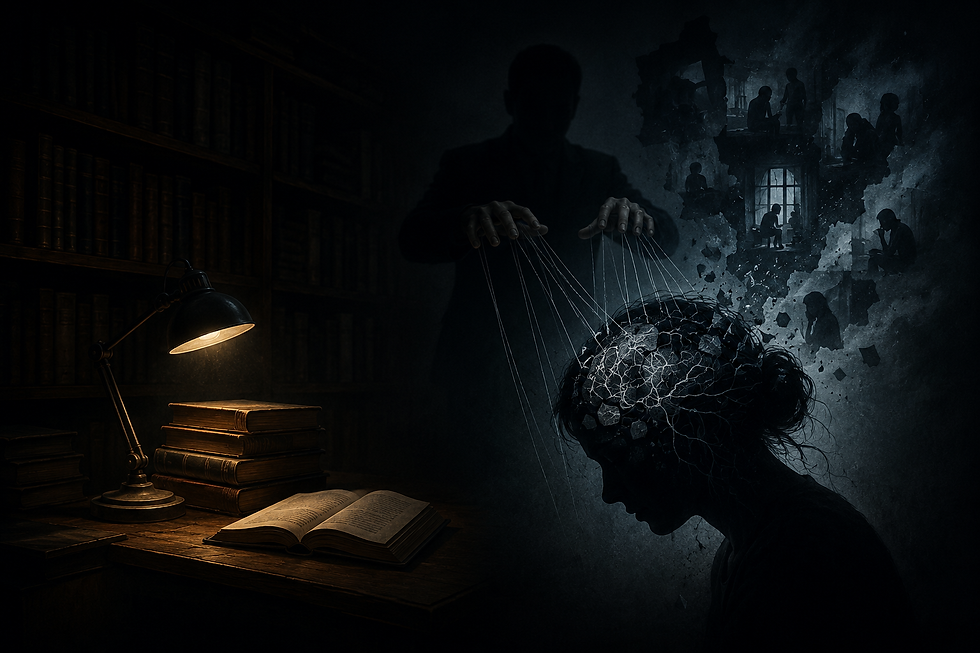
NOT because the evidence behind them is actually that strong.
The Body Keeps the Score became one of the most influential mental health books of the modern era because it offered something emotionally irresistible to modern culture:
a framework that explained suffering in a way that felt validating, scientific, compassionate, and morally clear all at once.
And to be fair, part of the book absolutely deserves credit.
Trauma is real.
Human experiences absolutely affect the nervous system, emotional regulation, stress responses, memory, relationships, and physical health.
None of that is controversial.
The problem is that the book — and especially the culture that formed around it — often presents speculative interpretations, selective findings, anecdotal narratives, and highly simplified neuroscience as though they represent settled scientific fact.
That distinction matters enormously.
Because once emotional explanations become wrapped in scientific language, most people stop questioning them.
Terms like:– nervous system– trauma response– stored trauma– dysregulation– survival mode– rewired brain
begin carrying the emotional authority of established medical truth even when the actual evidence behind many of the broader cultural claims remains incomplete, debated, limited, or highly interpretive.
This is one of the biggest problems in modern pop psychology.
Scientific terminology creates the appearance of certainty.
And certainty is psychologically comforting.
Especially for people in pain.
Throughout The Body Keeps the Score, emotionally compelling stories are repeatedly blended with neuroscience, brain imaging references, therapeutic anecdotes, and selective research findings in ways that strongly imply far more scientific consensus than actually exists.
And most readers are not trained to distinguish between:– rigorous scientific proof– preliminary findings– therapeutic theory– speculative interpretation– emotionally persuasive storytelling
Those are not the same thing.
One of the most culturally significant consequences of this book was the way it helped transform trauma from something people experience into something people increasingly organize their identities around.
That shift has had enormous cultural effects.
Today, entire industries increasingly encourage people to reinterpret large portions of ordinary human struggle through trauma frameworks:– relationships– motivation– emotional discomfort– attention problems– social anxiety– loneliness– conflict– identity confusion– addiction– even everyday stress itself
The result is a culture where many people no longer simply suffer.
They begin viewing themselves as fundamentally damaged nervous systems.
And once that identity forms, it can become incredibly difficult to separate healing from continued identification with injury.
That does not mean trauma is fake.
It does not mean suffering is fake.
And it certainly does not mean people are “making things up.”
But modern trauma culture increasingly treats highly complicated human experiences as though they can be cleanly explained through simplified neurological narratives that often exceed the actual strength of the evidence.
Real neuroscience is extraordinarily complex.
Messy.
Limited.
Evolving.
Full of uncertainty and competing interpretations.
Books like The Body Keeps the Score often compress that complexity into emotionally satisfying frameworks that feel definitive long before the science itself is definitive.
Because definitive explanations sell.
Especially in cultures filled with emotional pain, isolation, anxiety, and meaninglessness.
After spending decades inside mental health and human service systems, I have become increasingly aware of how often emotionally persuasive frameworks slowly harden into institutional truth.
A theory emerges.
The theory becomes culturally popular.
The language spreads through therapy, social media, education, treatment programs, and professional training.
Eventually questioning the framework itself begins to feel emotionally insensitive or even morally wrong.
And that is where caution disappears.
None of this means The Body Keeps the Score is without value.
Part of the reason the book became so powerful is because it speaks to something real: many people genuinely feel unseen, overwhelmed, emotionally fractured, and desperate for explanations that make their suffering feel coherent.
But emotional resonance is not the same thing as rigorous scientific certainty.
And modern culture increasingly struggles to tell the difference.
That may be the most important thing this book unintentionally reveals.
Not simply how trauma affects people.
But how easily emotionally satisfying narratives wrapped in scientific language can evolve into modern belief systems.
__________________________________________________________________________________
REFERENCES
van der Kolk, B. A. (2014). The Body Keeps the Score: Brain, Mind, and Body in the Healing of Trauma. Viking.
McNally, R. J. (2003). Remembering Trauma. Harvard University Press.
Lilienfeld, S. O., Lynn, S. J., & Lohr, J. M. (2015). Science and Pseudoscience in Clinical Psychology (2nd ed.). Guilford Press.
Devilly, G. J. (2005). Power therapies and possible threats to the science of psychology and psychiatry. Australian and New Zealand Journal of Psychiatry, 39(6), 437–445.
McNally, R. J. (2005). Debunking myths about trauma and memory. Canadian Journal of Psychiatry, 50(13), 817–822.
Paris, J. (2015). The intelligent clinician’s guide to the DSM-5. Oxford University Press.
Brewin, C. R. (2014). Episodic memory, perceptual memory, and their interaction: Foundations for a theory of posttraumatic stress disorder. Psychological Bulletin, 140(1), 69–97.


Comments