

No One Warns You About This Part of Getting Older
When we're young, we don't have to work very hard to find other people.
School surrounds us with friends.
College gives us roommates.
Workplaces become social circles.
Marriage creates built-in companionship.
Children fill the house with noise.
Even running errands means constantly bumping into familiar faces.
Life keeps putting people in front of us.
Then, almost without noticing, it changes.
The kids move away.
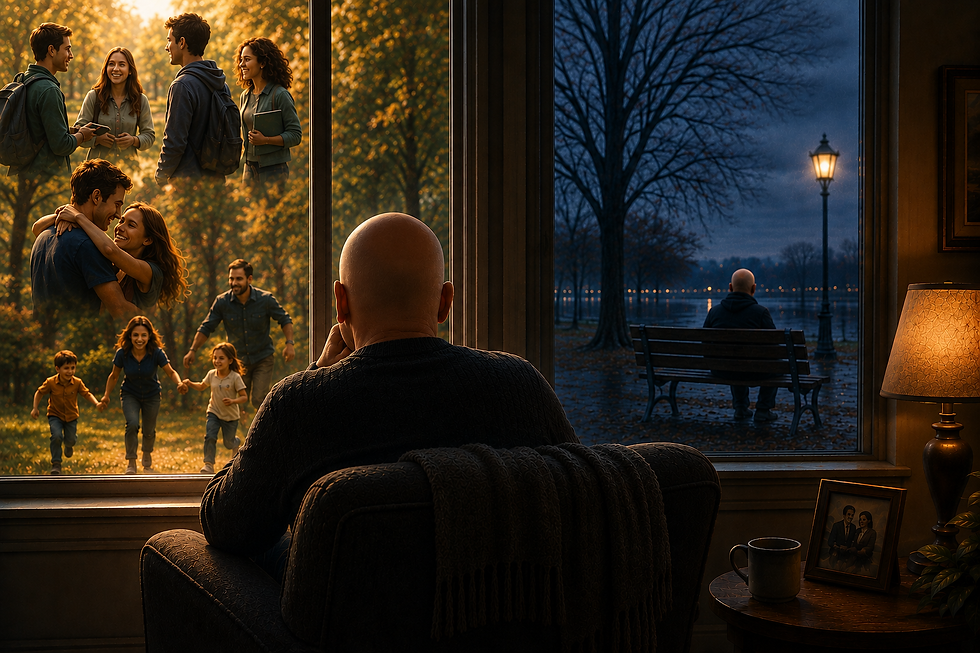
Parents become elderly—or they're gone.
Friends relocate, become busy with grandchildren, or quietly drift apart.
Coworkers retire.
Relationships end.
One day you realize you spent the entire weekend without having a real conversation.
Not because nobody likes you.
Because there was simply no place for it to happen.
The hardest part isn't always loneliness.
Sometimes it's something harder to describe.
It's a quiet feeling that you're becoming invisible.
You still have ideas.
You still laugh.
You still want to contribute.
You still have stories that would make people laugh.
But fewer people ask.
And after enough years, you stop volunteering them.
This isn't just emotional.
Humans evolved in tribes.
For hundreds of thousands of years, we rarely spent long periods completely alone.
Today it's possible to go days interacting only with cashiers, delivery drivers, and television personalities.
Our brains weren't built for that.
Loneliness isn't simply an unpleasant feeling.
Research has linked chronic loneliness with depression, anxiety, sleep problems, cognitive decline, heart disease, and even earlier mortality.
Connection isn't a luxury.
It's part of how we're wired.
What many people don't realize is that prolonged loneliness can also create anxiety.
When we spend long periods without meaningful human connection, our brains receive fewer signals that we're safe, accepted, and part of a community.
We laugh less.
We share less.
We receive less encouragement.
We spend more time alone with our thoughts.
For many people, that's when the mind begins filling in the silence.
Small worries grow larger.
Ordinary problems feel heavier.
The future seems more uncertain.
It's easy to assume something is wrong with you when, in reality, part of what you're experiencing may simply be the effects of too much isolation.
Human beings don't just survive through connection.
We regulate ourselves through it.
A conversation with a friend.
A shared laugh.
Someone asking how your day went—and genuinely wanting to hear the answer.
These ordinary moments calm the nervous system in ways we rarely notice until they're gone.
Many people may mistake this feeling for depression.
Others convince themselves they're simply "too old" to make new friends.
Neither is necessarily true.
Often what's missing isn't happiness.
It's regular, meaningful human connection.
The kind where someone knows your name.
Looks forward to seeing you.
Laughs at your jokes.
Asks how you're really doing.
The irony is that millions of people are quietly living the same story—spending more and more time alone while assuming everyone else has a full social life.
Two lonely people often pass each other every day believing they're the only one.
Each waiting for someone else to make the first move.
This is one reason I believe freedom isn't only about escaping controlling relationships or unhealthy systems.
It's also about building a life that keeps us connected.
A weekly class.
A volunteer position.
A book club.
A faith community.
A gym where people know your name.
A coffee shop where the barista notices when you've been gone for a week.
Purpose and connection protect us in ways we often don't appreciate until they're missing.
If you're in your 50s, 60s, or beyond and some evenings feel unusually quiet...
You're experiencing something that modern life has quietly created for millions of people.
The answer isn't pretending you don't need people.
It's recognizing that connection becomes something we have to create intentionally.
Not because we're weak.
Because we're human.


Comments