

Why Is Falling for Someone So Fucking Scary?
You meet someone. You enjoy their company. They make you laugh. You find yourself thinking about them when they're not around.
And somewhere along the way, you realize this person has become considerably more important to you than you ever intended.
Wonderful, right?
Then why the hell is it so terrifying?
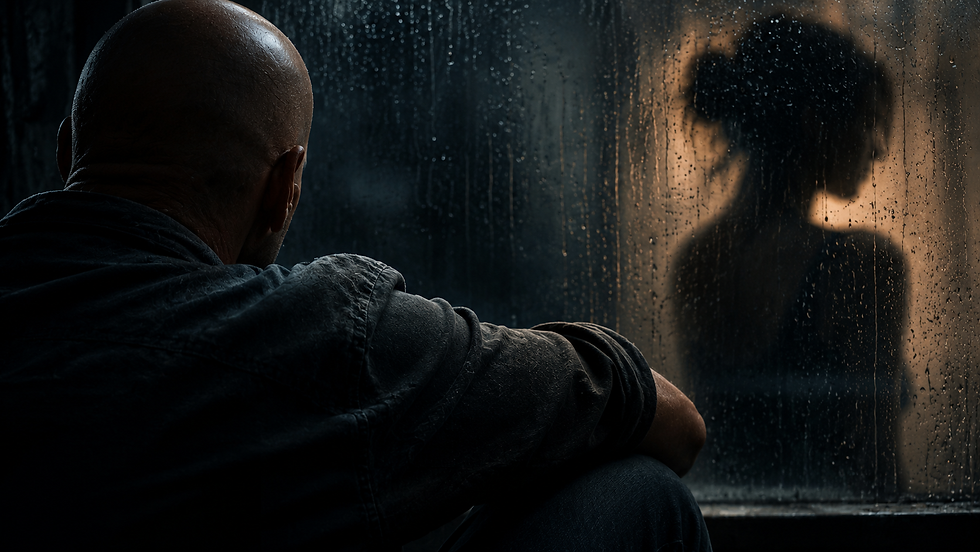
Because falling in love means giving someone the ability to hurt you.
Not because they're going to. They might be the kindest, most wonderful person you've ever met.
Which almost makes it worse.
You have no good reason to run.
So Much for Emotional Independence
There's something reassuring about being comfortable alone.
You know your routines. Your happiness doesn't depend on whether someone texts you back. You don't spend twenty minutes wondering what they meant by a three-word message.
Then someone comes along and screws up the entire arrangement.
Suddenly, you're checking your phone like a teenager, replaying conversations, and smiling at absolutely nothing.
And there's actually some science behind this nonsense.
Aron and colleagues (2005) found that intense romantic love activates brain regions involved in reward and motivation.
In other words, your brain starts treating this particular person as extraordinarily important.
Apparently, nobody asked your permission.
The Older You Get, the More You Know
At twenty, you might believe love conquers everything.
By sixty, you've learned that love doesn't necessarily conquer a damn thing.
People change. Relationships end. Promises get broken. Sometimes nobody does anything particularly wrong, and things still fall apart.
You've lived long enough to know that even the most beautiful beginning guarantees absolutely nothing about the ending.
And again, your brain doesn't make things easier.
Fisher and colleagues (2010) found that romantic rejection can activate brain systems associated with reward, craving, and motivation.
Think about that.
Your rational mind might know a relationship is over, while your brain is still desperately interested in the person who left.
What a ridiculous arrangement.
Maybe We're Afraid of Ourselves
Here's what I find particularly interesting.
Sometimes we're not afraid the other person will leave.
We're afraid of how much we're beginning to care whether they stay.
There's a difference.
When you've spent years being emotionally independent, suddenly needing someone can feel almost like losing control.
Attachment research helps explain why.
Li and Chan (2012), reviewing 73 studies, found that attachment anxiety and avoidance were associated with different relationship difficulties.
Some people respond to emotional uncertainty by clinging tighter. Others protect themselves by pulling away.
And some of us probably alternate between the two while congratulating ourselves on how emotionally mature we've become.
But perhaps the biggest problem is that genuine intimacy requires vulnerability.
Laurenceau and colleagues (1998) found that sharing personal feelings and experiencing a partner as understanding and responsive were important to developing intimacy.
Which sounds lovely until you realize that being genuinely known means allowing someone to see the parts of yourself you've spent years protecting.
And that's scary as hell.
Is Playing It Safe Really Worth It?
We could avoid all this.
Stay detached. Keep expectations low. Never allow anyone close enough to break our hearts.
And we'd probably avoid a considerable amount of emotional pain.
But what exactly would we be protecting?
Research suggests that responsive, supportive partners can help ease attachment insecurity (Overall et al., 2022). Being close to someone doesn't necessarily mean sacrificing independence.
Maybe the goal isn't to eliminate the fear.
Maybe it's to stop treating every uncomfortable feeling as evidence that something is wrong.
Because falling in love isn't a guarantee of happiness. It's a willingness to take an emotional risk without knowing how the story ends.
And at middle age or more, we should know better.
Which is precisely why it's so damn remarkable when we do it anyway.
Maybe the real tragedy isn't falling in love and having your heart broken.
Maybe it's becoming so afraid of heartbreak that you never let yourself fall in love again.
And wouldn't that be a hell of a thing to regret?
__________________________________________________________________________________
References
Aron, A., et al. (2005). Reward, motivation, and emotion systems associated with early-stage intense romantic love. Journal of Neurophysiology, 94(1), 327–337. https://doi.org/10.1152/jn.00838.2004
Fisher, H. E., et al. (2010). Reward, addiction, and emotion regulation systems associated with rejection in love. Journal of Neurophysiology, 104(1), 51–60. https://doi.org/10.1152/jn.00784.2009
Laurenceau, J.-P., Barrett, L. F., & Pietromonaco, P. R. (1998). Intimacy as an interpersonal process. Journal of Personality and Social Psychology, 74(5), 1238–1251. https://doi.org/10.1037/0022-3514.74.5.1238
Li, T., & Chan, D. K.-S. (2012). How anxious and avoidant attachment affect romantic relationship quality differently: A meta-analytic review. European Journal of Social Psychology, 42(4), 406–419. https://doi.org/10.1002/ejsp.1842
Overall, N. C., Pietromonaco, P. R., & Simpson, J. A. (2022). Buffering and spillover of adult attachment insecurity in couple and family relationships. Nature Reviews Psychology, 1, 101–111. https://doi.org/10.1038/s44159-021-00011-1


Comments