

The Domestic Violence System Isn’t Broken — It’s Incomplete
There’s a story we tell about domestic violence.
It sounds like this:
There’s a victim. There’s an abuser. There’s a crisis. And the system steps in to help.
Hotlines. Shelters. Protection orders. Counseling. Advocacy.
And to be clear — these things matter. A lot.
They save lives.
But they’re not the whole picture.
Not even close.
WHERE THE SYSTEM FOCUSES
The domestic violence system — what most people think of as shelters, advocacy, and support services — is built around one central moment:
Crisis.
When things get bad enough — when someone is in danger — when the situation becomes visible —
That’s when the system activates.
And when it does, it often does powerful work.
Emergency shelter. Legal protection. Safety planning.
All of that matters.
But here’s the problem:
It mostly shows up at the breaking point.
WHAT GETS MISSED
Domestic violence doesn’t start with a punch or a slap.
It starts much earlier.
Control. Isolation. Subtle intimidation. The gradual erosion of identity.
And this is where things get more complicated than the system tends to acknowledge.
Because many people living in these situations do not experience themselves as “victims” in the way the system defines it.
They experience:
Confusion. Attachment. Hope. Fear mixed with love.
And a constant internal negotiation about what to do next.
THE INVISIBLE PART
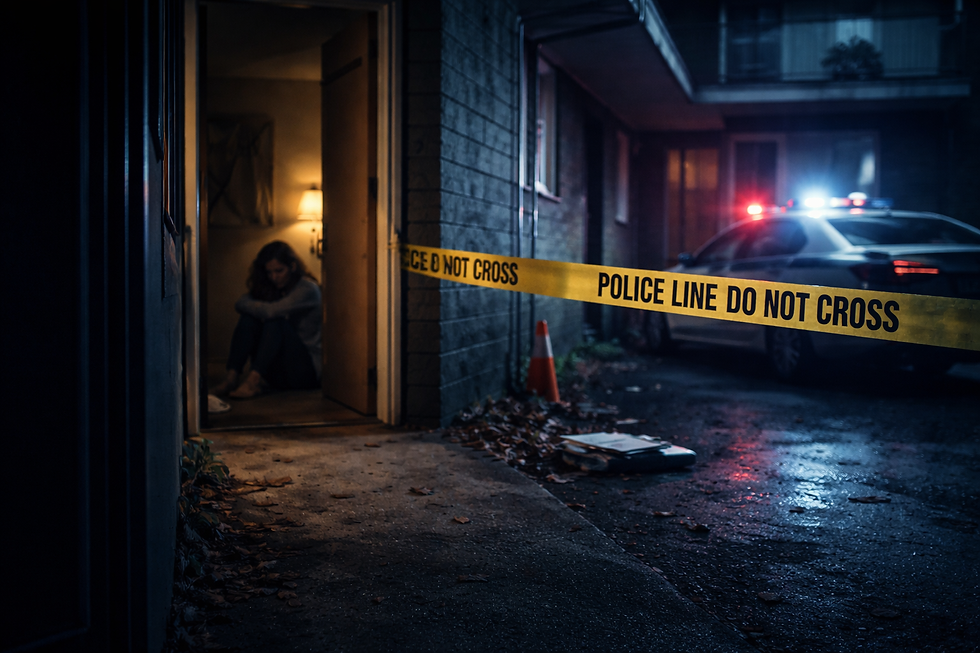
The system is very good at responding to visible harm.
It is far less equipped to deal with what happens internally over time:
The slow loss of a person’s sense of self
The erosion of confidence in one’s own judgment
The growing belief that leaving may not be possible
Because leaving is not a single decision.
It is a series of decisions.
And each one carries real risk.
Where to go. How to survive financially. What happens to children? What happens if things escalate?
THE LIMIT OF SUPPORT
Support matters.
Safety matters.
Resources matter.
But there is a limit to what support alone can do.
Because support can create the conditions for change —
but it cannot replace the process of a person rebuilding their own power.
WHAT ACTUALLY CHANGES THINGS
Real change doesn’t happen all at once.
It doesn’t come from a single intervention.
And it doesn’t come from someone else “fixing” the situation.
It happens when the victimized person begins to regain the ability to act.
Not perfectly. Not all at once.
But in real, tangible ways.
Because no one can hand a person their power back.
It is something that gets rebuilt through action.
Through choices. Through movement. Through doing things that begin to re-establish control over one’s own life.
WHERE YOUR POWER ACTUALLY IS
Up until now, this has been about “the system.”
But none of this is abstract.
This is about real people living inside it.
So let’s be direct.
A person’s power is not in waiting for the perfect moment.
It’s not in having everything figured out.
It’s not in fixing the past before taking action.
A person’s power is in:
Seeing clearly. Making one decision. Then another.
Not huge, life-changing decisions all at once —
but real ones.
Telling someone what’s actually happening — knowing it could get back to the person causing harm.
Hiding money — knowing it could be found.
Reaching out for help — while still planning to go back.
Saying “no” to something small — and bracing for the reaction.
Leaving for a night — with no clear plan for what comes next.
Looking at housing, jobs, or options — and realizing how uncertain all of it is.
These are not easy steps.
They carry risk. They create fear. And sometimes they make things more dangerous in the short term.
That’s the part that rarely gets said out loud.
And they’re often not big, dramatic moves.
They’re small decisions — the kind that don’t look like much from the outside, but start to shift something internally.
Because those are the decisions that begin to rebuild a person’s life.
FINAL THOUGHT
The domestic violence system isn’t broken.
But it IS incomplete.
It shows up at the moment of danger.
What it often misses is everything that comes before that moment…and everything that comes after.
The beginning — when something feels off, but there’s no language for it yet - when control is subtle. When doubt starts to creep in. When a person is still trying to make sense of what’s happening.
And the long stretch after — when the situation is clearer, but the path forward is uncertain. When decisions have to be made without guarantees. When a life has to be rebuilt piece by piece.
That entire span — from the first moment something doesn’t feel right to the last step of building something different —
is where the real work happens.
And it’s not simple.
It’s not clean. It’s not linear. It’s not safe in the way people like to imagine.
It takes a level of awareness most people never have to develop. It takes making decisions under pressure, fear, and uncertainty. It takes acting without guarantees.
That isn’t weakness.
That’s courage — whether it looks like it from the outside or not.
Because the truth is:
The hardest part of this isn’t just surviving the moment.
It’s recognizing what’s happening early — and rebuilding the ability to choose when that ability has been worn down over time.
And no system can do that for someone.
It can support it. It can protect it. It can make space for it.
But it cannot replace it.
Because the answer isn’t found in waiting for crisis or in someone else stepping in to fix it.
The answer is this:
A person begins to take their power back the moment they start making real decisions again— even while things are still unclear, even while they’re still in it.
That’s where it starts.
Not later. Not when everything lines up.
Right there — in the moment a person stops waiting and starts choosing.
Because in the end —
a life doesn’t change all at once.
It changes the moment a person starts choosing again.
And then keeps going.
This post draws on decades of research on intimate partner violence, coercive control, and self-efficacy.
__________________________________________________________________________________
REFERENCES
Anderson, D. K., & Saunders, D. G. (2003). Leaving an abusive partner: An empirical review of predictors, the process of leaving, and psychological well-being. Trauma, Violence, & Abuse, 4(2), 163–191. https://doi.org/10.1177/1524838002250769
Bandura, A. (1997). Self-efficacy: The exercise of control. W.H. Freeman and Company.
Campbell, J. C. (2002). Health consequences of intimate partner violence. The Lancet, 359(9314), 1331–1336. https://doi.org/10.1016/S0140-6736(02)08336-8
Dutton, M. A., Goodman, L. A., & Bennett, L. (1999). Court-involved battered women’s responses to violence: The role of psychological, physical, and sexual abuse. Violence and Victims, 14(1), 89–104.
Goodman, L. A., Thomas, K. A., Cattaneo, L. B., Heimel, D., Woulfe, J., & Chong, S. K. (2016). Survivor-defined practice in domestic violence work: Measure development and preliminary evidence of link to empowerment. Journal of Interpersonal Violence, 31(1), 163–185. https://doi.org/10.1177/0886260514555131
Stark, E. (2007). Coercive control: How men entrap women in personal life. Oxford University Press.
Sullivan, C. M. (2018). Understanding how domestic violence support services promote survivor well-being: A conceptual model. Journal of Family Violence, 33(2), 123–131. https://doi.org/10.1007/s10896-017-9931-6
Walker, L. E. (1979). The battered woman. Harper & Row.


Comments